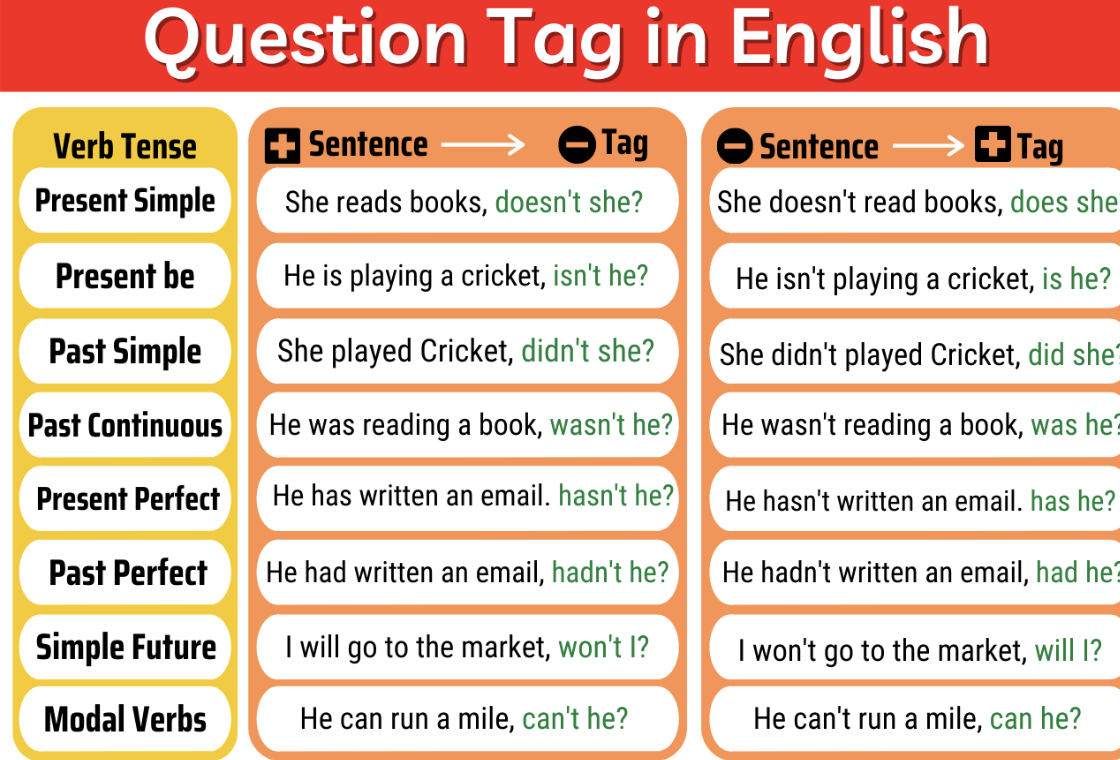
- What Are Question Tags? Question tags are short phrases added to the end of a statement to turn it into a question or to seek confirmation. They are used to engage the listener, elicit a response, or express uncertainty. Question tags are formed by combining an auxiliary verb and a pronoun.
- Common Auxiliary Verbs: Auxiliary verbs, also known as helping verbs, are used to construct question tags. The most common auxiliary verbs include:
- «Do» (present simple) or «did» (past simple)
- «Does» (present simple, third person singular)
- «Is,» «am,» «are» (present simple, present continuous)
- «Was,» «were» (past simple)
- «Has,» «have» (present perfect)
- «Can,» «could» (ability or permission)
- «Will,» «would» (future or willingness)
- Forming Question Tags: a) Positive Statement + Negative Question Tag:
- Statement: «She is a student.»
- Question Tag: «Isn’t she?»
b) Negative Statement + Positive Question Tag:
- Statement: «You don’t like coffee.»
- Question Tag: «Do you?»
c) Using the Appropriate Auxiliary Verb:
- Statement: «They have finished their homework.»
- Question Tag: «Haven’t they?»
- Agreement and Inversion: a) Agreement: The pronoun in the question tag agrees with the subject of the statement. If the subject is singular, the pronoun in the question tag is singular, and if the subject is plural, the pronoun in the question tag is plural.
- Statement: «He is tired.»
- Question Tag: «Isn’t he?»
b) Inversion: The auxiliary verb in the question tag is inverted with the subject of the statement.
- Statement: «You can swim.»
- Question Tag: «Can’t you?»
- Usage and Intonation: a) Seeking Confirmation: Question tags are often used to seek confirmation or agreement from the listener.
- Statement: «It’s a beautiful day, isn’t it?»
b) Softening Statements: Question tags can be used to soften statements and make them less assertive.
- Statement: «We should go, shouldn’t we?»
c) Emphasizing Uncertainty: Question tags can express uncertainty or seek reassurance.
- Statement: «She won the award, didn’t she? I can’t believe it!»
Deja una respuesta