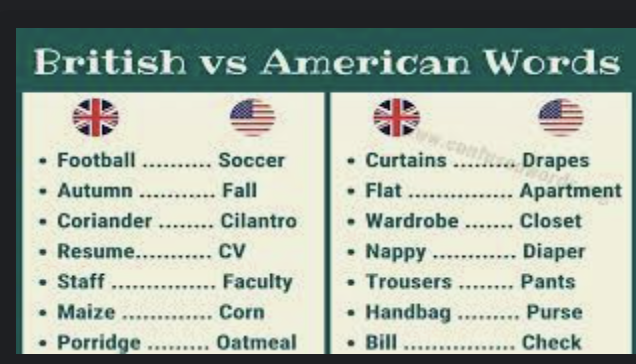
- Spelling Differences: a) Words ending in «-or» (American) vs. «-our» (British):
- American English: color, neighbor, honor
- British English: colour, neighbour, honour
b) Words ending in «-ize» (American) vs. «-ise» (British):
- American English: organize, realize, apologize
- British English: organise, realise, apologise
c) Words with «er» (American) vs. «re» (British) in certain contexts:
- American English: center, theater, meter
- British English: centre, theatre, metre
- Vocabulary Differences: a) Food and Beverages:
- American English: cookie, french fries, soda
- British English: biscuit, chips, fizzy drink
b) Transportation:
- American English: subway, vacation, trunk (of a car)
- British English: underground, holiday, boot (of a car)
c) Household Items:
- American English: elevator, trash can, apartment
- British English: lift, rubbish bin, flat
d) Clothing:
- American English: pants, sneakers, sweater
- British English: trousers, trainers, jumper
- Colloquial Expressions: a) American English:
- «Awesome!» (meaning excellent or great)
- «Cool!» (meaning good or impressive)
- «What’s up?» (meaning how are you or what’s happening?)
b) British English:
- «Brilliant!» (meaning excellent or fantastic)
- «Cheers!» (meaning thank you or goodbye)
- «How’s it going?» (meaning how are you or what’s happening?)
- Pronunciation Differences: a) Certain words are pronounced differently in American and British English. For example:
- American English: tomato (tuh-MAY-toh)
- British English: tomato (tuh-MAH-toh)
- Cultural References: Keep in mind that vocabulary differences can sometimes reflect cultural variations and references unique to each country. For example, certain terms related to sports, politics, or popular culture may differ between American and British English.
Deja una respuesta