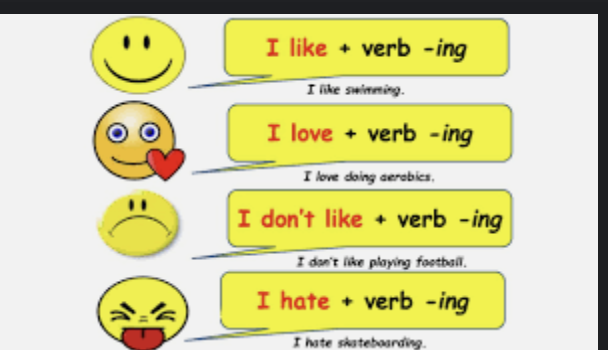
- Expressing Likes: When we want to express that we enjoy or have a positive feeling towards something, we can use «like,» «love,» or «enjoy» followed by the -ing form of a verb. Examples:
- «I like swimming in the ocean.»
- «She loves playing the guitar.»
- «We enjoy watching movies on the weekends.»
- Expressing Dislikes: To express that we dislike or have a negative feeling towards something, we can use «hate» or «don’t/doesn’t like» followed by the -ing form of a verb. Examples:
- «He hates doing chores around the house.»
- «They don’t like studying for exams.»
- «She doesn’t like waking up early in the morning.»
- Emphasizing Preferences: We can use these verbs to emphasize our preferences by adding adverbs like «really,» «absolutely,» or «completely» before the verb. Examples:
- «I absolutely love dancing to my favorite songs.»
- «He really enjoys playing video games.»
- «She completely hates doing homework.»
- Using «Like» in Comparison: «Like» can also be used to make comparisons or find similarities between two things or activities. Examples:
- «Running is like flying through the air.»
- «Cooking is like art; you create delicious masterpieces.»
- Note on Verb Forms: Remember to use the -ing form of the verb after «like,» «love,» «hate,» «enjoy,» or «don’t/doesn’t like.» Examples:
- «I like playing soccer.» (Correct)
- «I like to play soccer.» (Incorrect)
Deja una respuesta