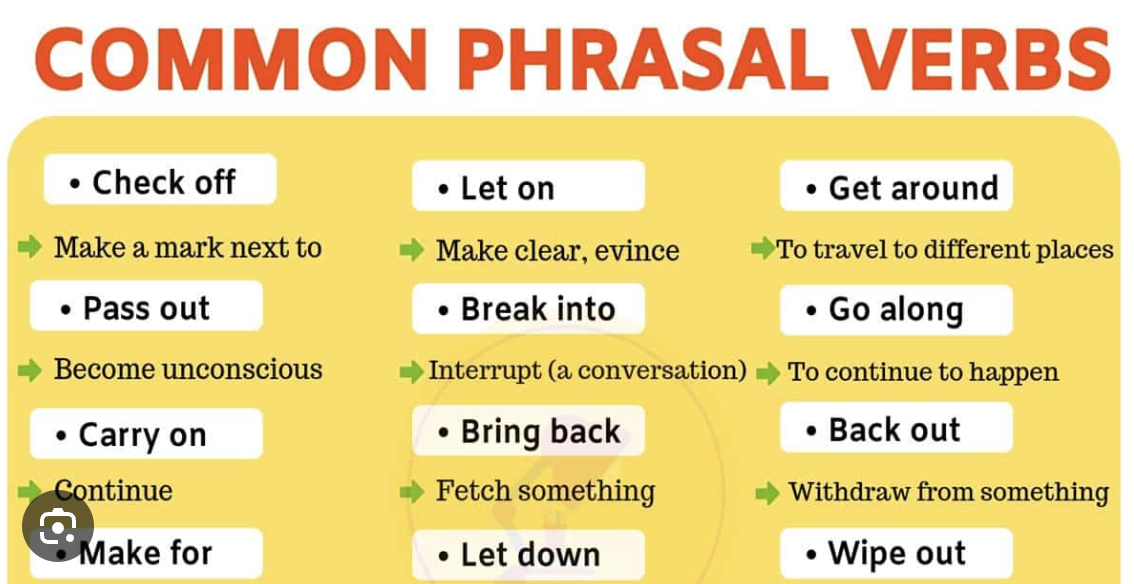
- What Are Phrasal Verbs? Phrasal verbs are combinations of a verb and one or more particles (prepositions or adverbs). They create idiomatic expressions that often have meanings different from the individual words. For example, «look up» means to search for information, while «give up» means to stop trying.
- Separable and Inseparable Phrasal Verbs: a) Separable Phrasal Verbs: In separable phrasal verbs, the verb and the particle can be separated by the object in a sentence. For example, «I turned the light off» or «I turned off the light.» The object can come between the verb and the particle.
b) Inseparable Phrasal Verbs: In inseparable phrasal verbs, the verb and the particle cannot be separated by the object. For example, «She broke down when she heard the news» or «She didn’t break down when she heard the news.» The object must stay after the particle.
- Common Phrasal Verbs and Their Meanings: a) «Get over» means to recover from something emotionally or physically. For example, «He needs time to get over the breakup.»
b) «Take off» means to remove something quickly or to become successful. For example, «Please take off your shoes» or «Her singing career took off after the talent show.»
c) «Bring up» means to mention or raise a topic in conversation. For example, «He brought up an interesting point during the meeting.»
- Using Phrasal Verbs in Context: a) Context is key when using phrasal verbs. Consider the meaning of the phrasal verb in the specific situation to ensure proper usage. Pay attention to the object, word order, and any changes in meaning when using separable or inseparable phrasal verbs.
b) Practice using phrasal verbs in sentences and conversations to become more comfortable with their usage. Incorporate them into your daily language practice to reinforce your understanding and fluency.
- Expanding Your Phrasal Verb Vocabulary: a) Read books, newspapers, and online articles to encounter phrasal verbs in context. Make a note of new phrasal verbs and their meanings.
b) Watch movies, TV shows, or videos in English to observe phrasal verbs being used naturally by native speakers. Pay attention to the context and intonation to grasp their meaning effectively.
Deja una respuesta