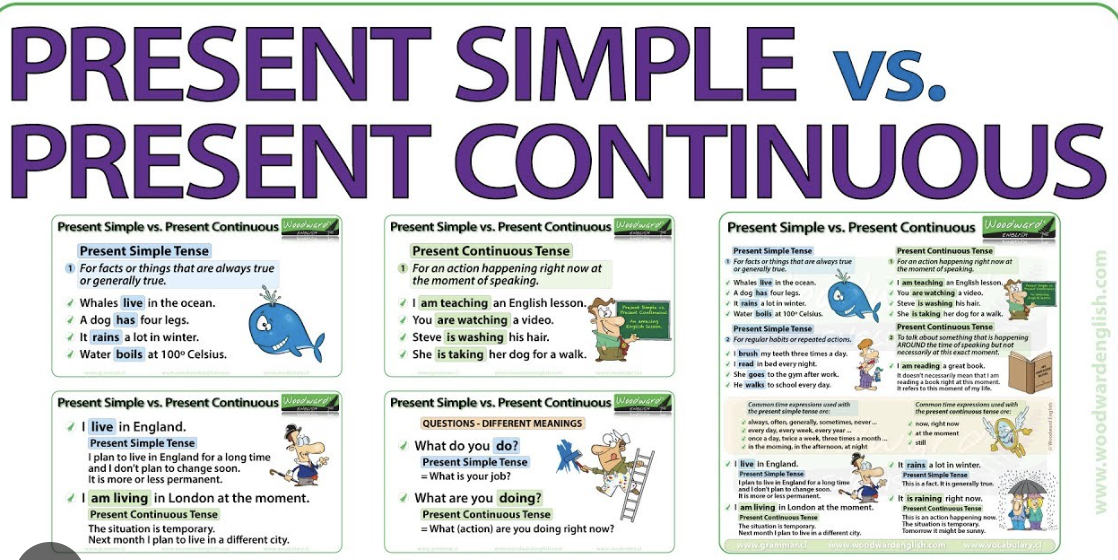
- Simple Present Tense: The simple present tense is used to describe habitual actions, general truths, or permanent states of being. It focuses on actions that are repeated, routines, or facts that are generally true.Example:
- «I eat breakfast every morning.»
- «Cats are mammals.»
- Present Continuous/Progressive Tense: The present continuous/progressive tense is used to describe actions happening at the current moment, temporary situations, or actions in progress. It emphasizes actions that are ongoing or occurring at the time of speaking.Example:
- «She is reading a book right now.»
- «They are playing soccer in the park.»
- Formation of Simple Present Tense: To form sentences in the simple present tense, use the base form of the verb (infinitive) without any changes for most subjects.Example:
- «I eat dinner at 7 p.m.»
- «They study for exams.»
- Formation of Present Continuous/Progressive Tense: To form sentences in the present continuous/progressive tense, use the present tense of the verb «to be» (am, is, are) as the helping verb, followed by the present participle form of the main verb, ending in «-ing.»Example:
- «She is cooking dinner right now.»
- «We are watching a movie together.»
- Usage of Simple Present Tense: The simple present tense is used for:
- Habits and routines: «He goes to the gym every day.»
- General truths and facts: «The Earth revolves around the sun.»
- Permanent situations: «She lives in New York.»
- Usage of Present Continuous/Progressive Tense: The present continuous/progressive tense is used for:
- Actions happening at the current moment: «I am writing an article now.»
- Temporary situations: «They are staying at a hotel during their vacation.»
- Actions in progress: «He is studying for his exams this week.»
- Expressing Future with Present Continuous/Progressive Tense: The present continuous/progressive tense can also be used to indicate future plans or arrangements when combined with time expressions or context.Example:
- «I am meeting my friends for lunch tomorrow.»
- «She is traveling to Paris next week.»
- Practice and Application: To solidify your understanding of the simple present and present continuous/progressive tenses, practice forming sentences using each tense. Engage in conversations, write paragraphs describing your daily routines, or discuss ongoing activities with your classmates. The more you practice, the more natural and accurate your usage will become.
Affirmative, negative and question for Simple Present vs. Present Continuous/Progressive
Simple Present Tense:
Affirmative:
She plays tennis every weekend.
They study English at the library.
We eat dinner together as a family.
Negative:
She does not play tennis every weekend.
They do not study English at the library.
We do not eat dinner together as a family.
Question:
Does she play tennis every weekend?
Do they study English at the library?
Do we eat dinner together as a family?
Present Continuous/Progressive Tense:
Affirmative:
She is playing tennis right now.
They are studying English at the library.
We are having dinner together tonight.
Negative:
She is not playing tennis right now.
They are not studying English at the library.
We are not having dinner together tonight.
Question:
Is she playing tennis right now?
Are they studying English at the library?
Are we having dinner together tonight?
Deja una respuesta